
I. Why Are Coal Mines in Shenmu Rushing to Install Emergency Power Supplies?
Where is Shenmu?
It is one of China’s most important coal-producing regions. The Jurassic coalfield has proven reserves of over 50 billion tons. Featuring high-quality coal with shallow burial depth, it is a rare national base for premium thermal coal and chemical coal.
Coal mines here are large-scale with high production capacity and extensive underground working faces. Precisely for this reason, power supply safety becomes exceptionally critical.
According to the Coal Mine Safety Regulations, a mine must have two independent power supply circuits. If one circuit fails, the other shall bear the full load. Theoretically, this “dual-circuit power supply” is standard configuration for coal mines.
However, reality is far more complicated than theory.
In September 2024, a power supply failure occurred at Heshun Tianchi Energy in Shanxi. Both circuits lost power simultaneously, and the main ventilation fan stopped supplying airflow for 1 hour and 38 minutes. Gas over-limit events took place 36 times at 26 underground locations. At one working face, the gas concentration peaked at 12.19%.
What does 12.19% mean? The lower explosion limit of gas is 5%. Any concentration above 5% falls within the explosive range, and 12% far exceeds the safety threshold. It was purely by luck that no casualties occurred in that accident.
For this reason, regulatory policies have been fully tightened.
In 2025, Shanxi took the lead in issuing official documents requiring all operating underground coal mines across the province to equip emergency power supplies. High-gas mines shall complete installation by the end of June 2026, and all other coal mines by the end of December 2026. This is not a suggestion; it is a mandatory requirement.
Shaanxi is following suit. Coal mines in Shenmu, Fugu and other areas have successively launched emergency safety power renovation. The tender announcement for Longde Coal Mine shows that the delivery period for a high-voltage diesel generator set is only 60 days from contract signing. The schedule is tight and the task is non-negotiable.
For coal mines in Shenmu, the question is no longer “whether to install emergency power”, but “when to finish installation”.
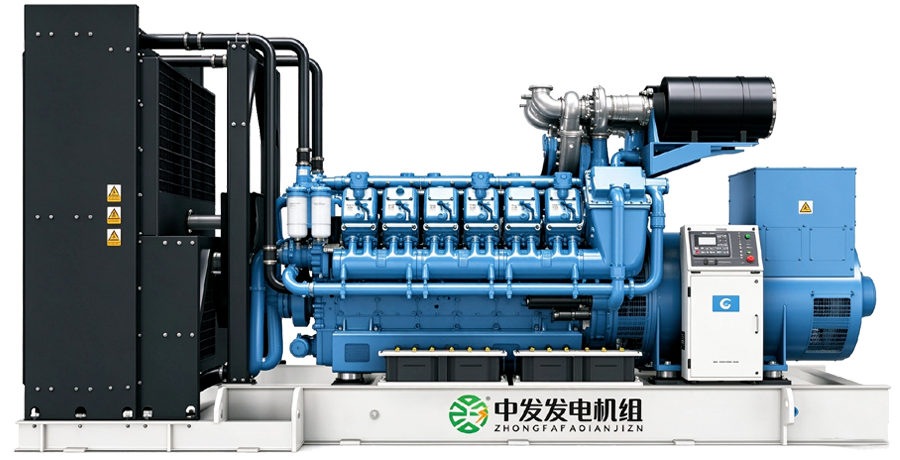
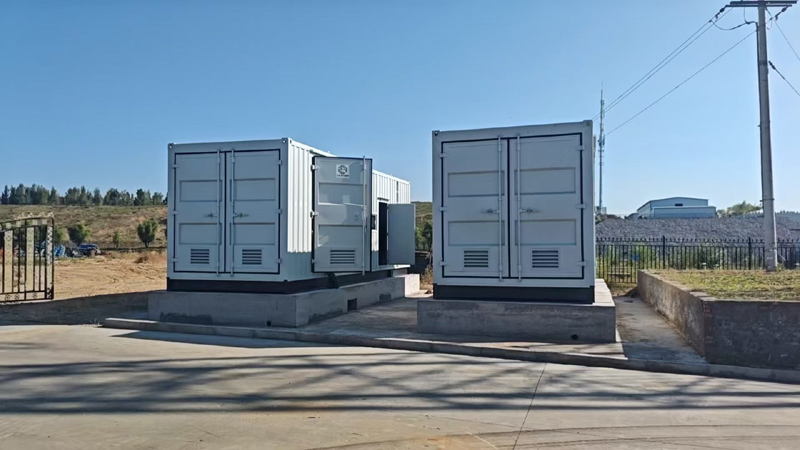
II. Why Two 1200kW Units?
Is a single 1200kW unit insufficient? Why deploy two units?
The answer is simple: this is redundancy design, not merely adding extra capacity to meet numbers.
The mine’s emergency power supply must cover three core loads: main ventilation fans, underground drainage pumps and vertical shaft personnel hoisting equipment. None of these can stop operation. If the main ventilation fan shuts down, gas accumulates underground; if drainage pumps stop, the mine may flood; if the hoisting system fails, miners cannot safely evacuate to the surface.
The challenge is that the total combined load of these three pieces of equipment can barely be supported by one 1200kW unit running at full load. When it comes to emergency power, “just enough capacity” is the biggest risk.
What if the unit breaks down at the critical moment? What if instantaneous load fluctuation exceeds expectations? What if continuous operation longer than 2 hours is required?
Therefore, the two 1200kW units serve as mutual backups: one in operation and the other on hot standby. In case of abnormality in either unit, the other can automatically take over within seconds. This is the genuine “dual safety backup”.
During preliminary technical communication, Zhongfa Power’s engineering team worked with the mine side to recalculate all primary safety-critical loads of the entire mine. Every item including main ventilation fans, drainage pumps, hoists, emergency lighting and dispatch communication systems was calculated, covering power rating, starting mode and starting current.
The final conclusion: two 1200kW units, one primary and one standby, operating independently with mutual redundancy. The configuration was derived from precise calculation rather than arbitrary decision.
III. Why High-Voltage Units Are Indispensable for Coal Mines
Both units adopt high-voltage output design.
Many people may wonder: can coal mines use low-voltage units? Can 380V generators also produce electricity?
One figure explains it clearly.
The power distribution room of a coal mine is at least several hundred meters away from the wellhead; in some mines, the distance reaches over one thousand meters. If 380V low-voltage power transmission is adopted, high current leads to severe line loss and dramatic voltage drop over long distances. Extra-thick cables are required, pushing costs sharply upward.
High voltage works differently. Higher voltage reduces current. With the same power capacity, much thinner cables can be used, and transmission loss over long distances is nearly negligible. Moreover, high-voltage power connects directly to the mine power distribution system without additional step-up equipment, resulting in fewer fault points and higher efficiency.
More importantly, high-voltage units deliver faster response. Once mains power fails, the unit must complete self-starting, voltage build-up, closing and load connection within an extremely short window. The high-voltage direct output scheme reduces intermediate links and shortens switching time.
On the commissioning day, Zhongfa Power engineers simulated sudden mains power outage. The two units responded automatically according to preset logic. From the trigger of power loss signal to stable loaded operation of the units, the whole process ran smoothly without interruption.
Lao Liu from the mine stood before the control screen and observed the waveform for a long time, then commented: “The switching waveform is smooth with no spikes.”
A smooth waveform means the transition of voltage and frequency is gentle and will not cause impact damage to underground equipment. Professionals can spot this advantage at a glance.
IV. Three Questions Raised by Lao Liu During Commissioning
Lao Liu has spent his whole career working on coal mine electromechanical systems and witnessed numerous equipment commissioning projects. He stayed on site throughout the commissioning of the two 1200kW units.
Question 1: “If both units run at full load, how long can the fuel tanks sustain operation?”
The engineer pulled up parameters of the fuel system: “Each unit is equipped with an independent fuel tank. At full load, the continuous runtime of a single unit meets emergency duration requirements. For prolonged full-load operation, external fuel tanks can be connected for refueling at any time.”
Lao Liu nodded.
Question 2: “If one unit fails to start, how quickly can the other take over?”
“The standby unit remains on hot standby. Upon receiving the switching signal, it automatically starts and takes on load within several seconds with no manual intervention.”
Lao Liu followed up: “How do you verify the reliability of automatic switching?”
“We carried out complete interlock tests during commissioning. We simulated fault signals of the primary unit to trigger automatic takeover by the standby unit. Interlock logic on both sides has been validated to avoid two units starting simultaneously or failure of the standby unit to activate when needed.”
Question 3: “After your team leaves, can our electricians operate the equipment?”
This question gets to the core. No matter how good the equipment is, it is useless if operators cannot use it properly.
The engineer opened a thick operation manual and turned to key pages: “No-load trial run, load test, switching drill and routine inspection — every procedure lists clear steps and judgment criteria. After handover, we will deliver on-site training. Your electricians can follow the whole workflow and conduct regular monthly trial runs independently afterwards.”
Lao Liu smiled: “This is practical. Good equipment only works when operators know how to use it well.”
V. Two Units, A Peace of Mind for an Entire Mine
What does the arrival of the two 1200kW generator sets mean for this coal mine?
It means the main ventilation fans will definitely start within the specified time after dual-circuit power loss; underground drainage pumps will not stop due to blackouts; the hoisting system is ready to lift personnel safely to the surface at any time.
A statement in the Shanxi official document reads: “The basic objective of emergency power configuration is to ensure safe personnel evacuation under sudden emergencies.”
Simply put: as long as these two units are online, underground workers have an escape route.
Zhongfa Power is honored and responsible to participate in this project and deliver emergency power security for this Shenmu coal mine.
Two 1200kW units, commissioned successfully in one go and fully put into service.
This is not merely advertising; it is the true story of two generator sets successfully delivered on site.
If your mining area, construction site or project requires high-voltage genset emergency power solutions, please feel free to contact us. Zhongfa Power specializes in generator sets and safeguards every critical scenario with professional expertise.